
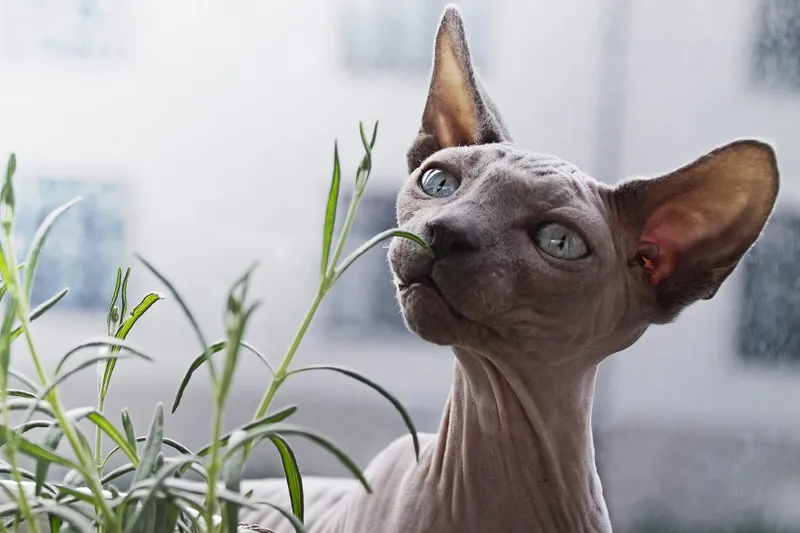
Which smells do cats dislike?
Which smells do cats dislike — and why? Are there reasons why cats react more sensitively to certain odors than others?
Cats dislike a wide range of smells. Their very sensitive noses can perceive odors that we humans can’t detect at all — and they perceive them much more intensely (or rather: with far more detail).
In one aspect, however, they’re just like us: depending on personality and life experience, smells are perceived as more or less pleasant or unpleasant.
A large part of odor perception is driven by instinct and genetics. That means many smells that had negative effects on cats’ ancestors are also perceived as unpleasant by domestic cats today.
This includes, for example, smells from tracks and markings of former predators, or the scent of plants and animals that were inedible or poisonous.
- See also ⇒ How to keep cats away effectively
Of course, this is a simplified explanation. Many more factors play a role. The effects of natural evolution are much more complex than described here — a detailed explanation would go beyond the scope of this article.
Smells cats avoid most often
Cats mainly avoid sour and pungent smells. This includes the scent of citrus fruits, but also the smell of onions. So, if you want to keep a cat away from something, it can help to use citric acid, onion water, or vinegar.
Commercial repellents are more precisely tuned. They often create artificial scents that sit in a narrow part of the “scent spectrum”: strongly noticeable for cats (and other four-legged animals), but almost impossible for humans to smell. Repellent sprays come in different formulations. If one doesn’t work for your pet, try another. There is no universal solution that works for every single animal.
If these methods didn’t help and your cat urinated in an unsuitable place, you can use cleaners based on microorganisms — for example dipure® Bio Urin Attacke.
Genetics also plays a big role: some people can perceive these odors, while some animals ignore them. The same principle is also why dog whistles exist — which are barely audible for humans. Similarly, only some people notice an unpleasant urine smell after eating asparagus.
Smells are on a spectrum
Similar to the light spectrum — where humans cannot see infrared or ultraviolet — smell works in a comparable way. Cats and other animals can detect odors outside of our perceptible range. But unlike light, smells can trigger strong instinctive and personal reactions. For a cat, a single smell can be as informative as an entire painting is to our eyes.
Put differently: a single smell can trigger a reaction in a cat similar to what some people feel when they see a spider.
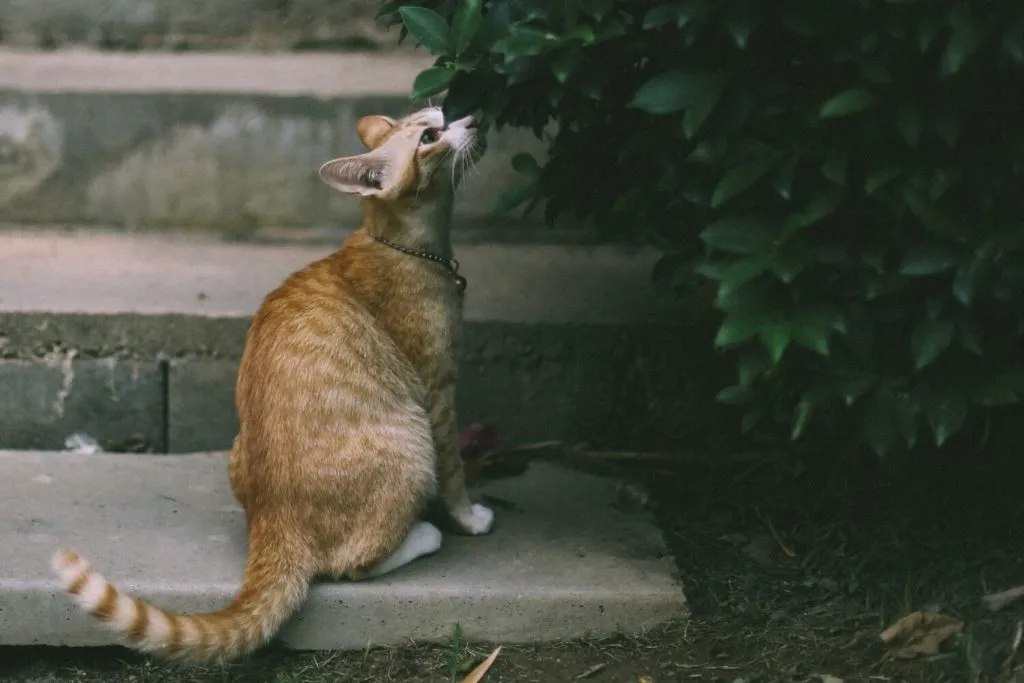
Summary
Cats differ greatly when it comes to how they perceive smells — just like humans. In general, sour or pungent smells such as lemon, vinegar, or onion can work as deterrents. Repellent sprays work through special scents that are perceived by animals, but not by humans.
There is no universal solution that works for all animals and at the same time is not perceived by any human. We are simply too different.
See also ⇒ How to keep cats away effectively
This post is part of a series about cat behavior in the household.
Updated on 27.02.2023