
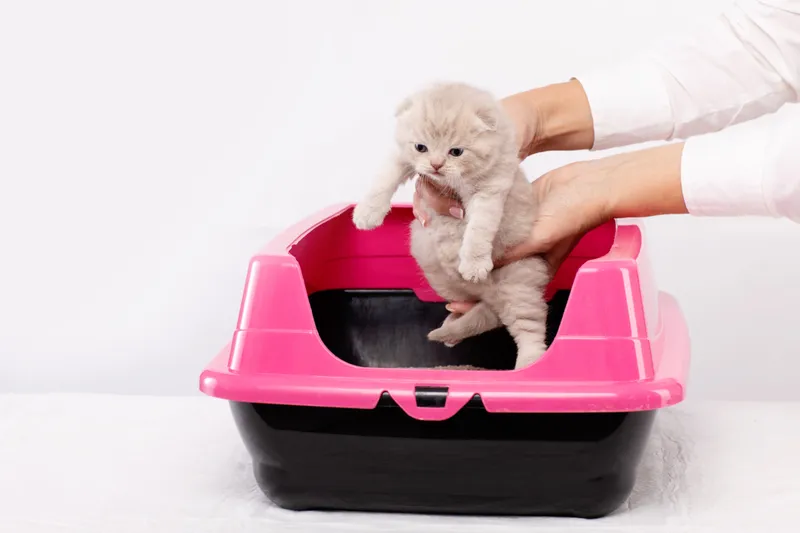
Cat Peeing in Bed - Cause and Solution
Cats are great. Except when they’re not. Every cat owner has experienced one or more “Why?-situations” with their cat or cats. And we’re going to clear up exactly these situations now. Whether the cat pees on the bed, the sofa, or the carpet, we have the solution.
- To properly clean cat urine and avoid mistakes, we’ve created a detailed guide that explains all the necessary steps and helps you proceed effectively. Our guide to cleaning cat urine provides you with the necessary tips and tricks.
The cause, as so often, lies in instincts and learned behavior.
As a warning in advance: Not all of the tricks and methods explained here will work equally well for all cats. Cats have very different and individual personalities and motivations.
The Causes
Instincts Are to Blame
Instincts protect cats. Like us humans, instincts are there to protect us from danger and guide us in unfamiliar situations.
Cats have a deeply rooted instinct that makes it so easy to get them used to litter boxes. Much easier than is the case with puppies, for example.
This instinct causes cats to naturally want to bury their urine and feces. This comes from the fact that cats in the wild are dangerous hunters, but also vulnerable prey. Burying urine and feces helps to cover tracks.
However, cats don’t learn to bury their waste solely through their instinct, but also from their mother. The mother cat shows her kittens where and how to bury their waste. However, the young kittens don’t understand the actual why behind it. They follow their instinct and their mother’s instructions without really comprehending why burying is necessary.
You can use your cat’s instincts to your advantage to keep them away from unwanted places. By encouraging certain behaviors, you can achieve different goals. Learn more in our article How to use a cat’s instincts to keep them away.
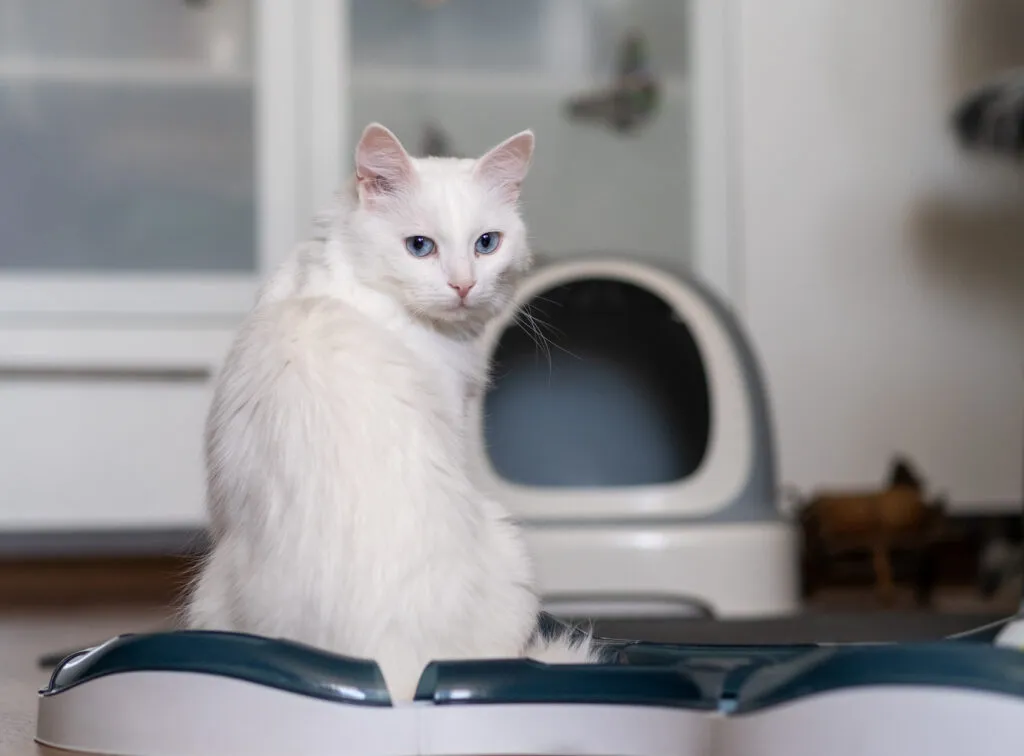
Cats don’t like to share their toilet. As a rule, there should always be one more litter box available than there are cats in the household. So with 2 cats = 3 toilets.
What Is a Litter Box?
A litter box is easy for us to define. It’s the tray into which we put the cat litter. However, a cat recognizes its box in a completely different way, and this depends heavily on the circumstances under which it grew up.
Fundamentally, cats recognize their litter box by smell, which is one of the most important triggers. In nature, cats bury their waste primarily to hide the smell from predators. But it makes sense to do this where the smell already exists, rather than laying new tracks.
Unfortunately, distance plays a role here. If the already-used box is too far away or not currently within nose range, the search for a new box quickly begins.
The second trigger is the softness of the ground. Here it quickly becomes clear why a cat can so easily confuse the litter box with a soft bed or sofa cushion.
Cats do their business where the ground is soft enough for burying. However, the instinctive trigger is not designed for modern bedroom furnishings, but for nature. In nature, there are no surfaces that are simultaneously soft and yet unsuitable for burying, like a duvet or pillow.
Therefore, cats quickly confuse a soft surface like a duvet with the soft ground in nature.
Add to this the incredible absorbency of the (foam) fabric. The cat urine is absorbed in seconds and the cat is more than satisfied with its “burying”. This ensures that the cat recognizes this spot as an effective toilet and remembers it for the future.
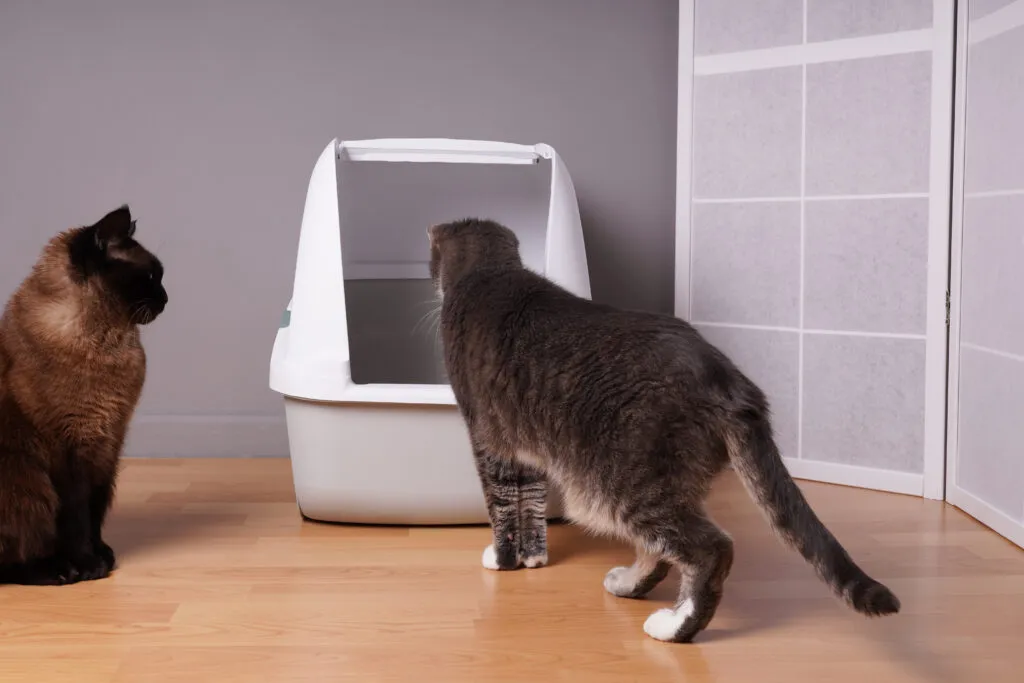
Cats don’t always feel comfortable in enclosed toilets, as they have no escape route there in one of their most vulnerable moments.
Why a Cat Rejects the Litter Box
Cats are very clean animals. Above all, they have extremely sensitive paws and noses. If a cat rejects its litter box and instead pees on the bed, this can have various causes:
-
The litter boxes are not clean enough
-
The litter boxes smell too strong
-
The litter boxes are placed in too busy a location
-
The litter box smells like another cat that may be unpopular with the unclean cat, whether due to short-term or long-term territorial tensions.
Territorial Tensions and Litter Boxes
Territorial tensions can play a major role in why a cat avoids the litter box. The smell of another cat can trigger uncertainty or even stress in your cat, especially if there have been confrontations or rivalries in the past.
Such tensions often arise when multiple cats are supposed to use the same box, and one of the cats shows a dominant attitude toward the others. For the subordinate cat, this means that it perceives the litter box as an unpleasant or even threatening place, which is why it refuses to use it. In such cases, it can help to provide several litter boxes in different locations so that each cat has its own protected toilet. Additionally, open litter boxes are often better suited, as cats feel less confined in them and such tensions occur less frequently.
However, open litter boxes are very unpopular with us humans, as the smell can be quite intense. There are litter additives that help keep these odors as low as possible while still in the litter box. Completely preventing the smell, however, is impossible without a lid and air filtration.
It can also happen that the cat is incontinent for health reasons and therefore pees on the bed or carpet for the first time. After that, the usual factors ensure that this spot becomes the new toilet.
If I do free a spot from cat urine and odor, why does my cat still go there again?
A cat has a very keen sense of smell. Just as we humans rely primarily on our sight, cats rely on their nose. Cats can not only recognize more details in smells, but also perceive much weaker odors than we can. This ensures that cats often perceive odors that are absolutely undetectable to us.
Additionally, there’s the problem that cats remember things. A pillow that once worked great as a toilet will gladly be used again, even if it’s odor-free.
Otherwise, cats wouldn’t use their litter box after a complete cleaning either.
The Solutions When the Cat Pees in Bed
To get the cat to stop peeing on the bed, you need to outsmart the cat’s instincts. You need to make it clear to the cat that the spot it has chosen is not a suitable place.
As a rule, punishing the cat doesn’t help. It will quickly figure out that the punishment only happens when people are around and will then do it when no one is looking.
Unlike dogs, cats don’t feel an innate need to please people. Instead, punishments can often create more problems than they solve.
How Do I Prevent My Cat from Peeing on the Bed?
If the cat has already discovered the bed as a new litter box, the first step is to eliminate the smell, as this is the strongest trigger.
Make the Bed an Unsuitable Toilet
-
You should use an odor remover like Bio Urin Attacke as this gives you the best chance of success. Microorganisms help reach spots that we as humans can no longer perceive. Learn more about cleaning cat urine here.
-
Keep the cat away from the spot. For at least a few days, the cat should not have the opportunity to visit this spot in order to get used to the usual litter box again. If it’s not possible to keep the cat away from the room, there are other options such as placing aluminum foil over the spot (many cats don’t like the feel and sound) or placing a solid object over the spot (e.g., a wooden board).
Offer the Litter Box as a Better Alternative
-
Place one of the litter boxes as close as possible to the spots. If the cat has peed on the bed, for example, it’s helpful to place the litter box next to the bed, preferably in the direction from which the cat enters the room.
-
Now move the litter box a little further toward the original location every day. The slower this process is, the safer. The cat will then slowly but surely get used to the location of the litter box again.
Keep the litter box as clean as possible during this time, but don’t clean it with harsh agents during this period so that the cat recognizes the smell and isn’t deterred.
- Use a probiotic litter box additive like dipure® Bio Urin Attacke Crystals. This helps keep the odors of the litter boxes under control. Especially effective when the cat avoids the box due to too strong odors or due to odors from other cats.

This is just one of many methods by which cats can be made to use the litter box again. If this method doesn’t work, you’ll soon find many more articles on this topic here with us.
This article is part of a series on cat behavior in the household.
Updated on October 11, 2024