
Smelly Drain! - What Helps Against Drain Odor.
Although all drains in our homes or apartments have an odor trap, unpleasant smells still occur from time to time. These accumulate directly through dirt in the pipe. When the drain smells, you need to act quickly. This drain odor is rarely pleasant. Moreover, the smell indicates an impending blockage.
How is a Drain Constructed?
Of course, each type of drain has its peculiarities and differences. Nevertheless, the principle is usually the same. Let’s first look at a standard sink drain:
For sinks that meet the standard, you’ll find the following parts in the drain, from top to bottom:
- Drain valve
- Form ring
- Valve bottom part
- Dip tube
- Siphon
- Connection piece to the sewer line
The first three parts (drain valve cup, form ring and valve bottom part) are also called “inlet fitting” in technical language.
Note: Kitchen sinks have a number of additional parts, and the drain of bathtubs and showers also contains somewhat different parts.
Do you want to keep your drain permanently free and odor-free? With a microbiological drain cleaner you can easily achieve this while being environmentally friendly!
Inlet Fitting
With the standard inlet fitting, only the drain valve lies in the basin. Form ring and valve bottom part are located below the sink.
A closure with rubber stopper, which is used for stainless steel sinks, is no longer found in modern sinks. In its place, a so-called drain plug is used. This is moved via a lever mechanism that raises or lowers the closure and thereby opens or closes the drain. This type of closure also helps prevent large objects from getting into the drain and thus being able to clog it.
Dip Tube
The dip tube connects the valve bottom part and the siphon. The length of the dip tube is crucial to get the appropriate height to the sewer connection.
Siphon
The so-called siphon is a very important part, because it is an odor trap that prevents foul smells from rising from the drain or from the sewer lines.
In principle, a siphon is simply a curved pipe section that is installed between the dip tube and the connection piece to the sewer line. This type of siphon is therefore also called a tubular siphon.
Other types of siphons are:
- Bottle siphon (these are mainly used for very low, often floor-level shower trays)
- Immersion wall closures
- Bell odor traps
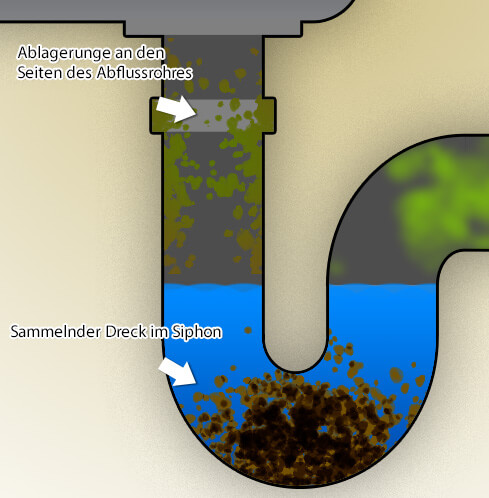
Siphons are particularly susceptible to blockages in the drain. Therefore, you should regularly check and clean the siphon. Settled substances accumulate at the bottom of the siphon, which over time form a viscous, foul-smelling slime. This is also a source of drain odor.
Connections on the Siphon
The siphon is connected on one side to the dip tube and on the other side to the sewer line using a connection piece.
The connection piece to the water line can be either a PVC pipe or a flexible hose. The latter, of course, makes adjusting the connection much easier.
What Material is a Drain Made Of?
Drains can be made of both PVC and metal. Frequently used materials are chrome-plated metals, such as stainless steel or brass, or plastic. Metal siphons usually cost a little more, but are also visually more attractive, more robust in terms of material and much more resistant to aggressive drain cleaners.
How Can a Drain Get Clogged?
There are various ways a drain can get clogged, which of course also depends on where it is used.
In the bathroom, it’s often hair and soap residue, while in kitchen drains it’s more likely to be grease, protein and other food residues.
But of course, in both cases, blockages can also occur due to objects that accidentally get into the drain, such as jewelry, glass shards, etc. In children’s bathrooms, it’s often small toys or parts of them.
In the toilet, on the other hand, it’s mainly too much toilet paper or toilet articles accidentally thrown into the toilet bowl, such as sanitary pads, tampons, wet wipes, etc.
Is There a Difference Between Sink Drain and Shower Drain?
As already mentioned above, there are different types of siphons, which are the part of the drain that requires the most space. For low shower trays, a different type of drain is used than for wash or sink basins.
What Causes Odors in the Drain?
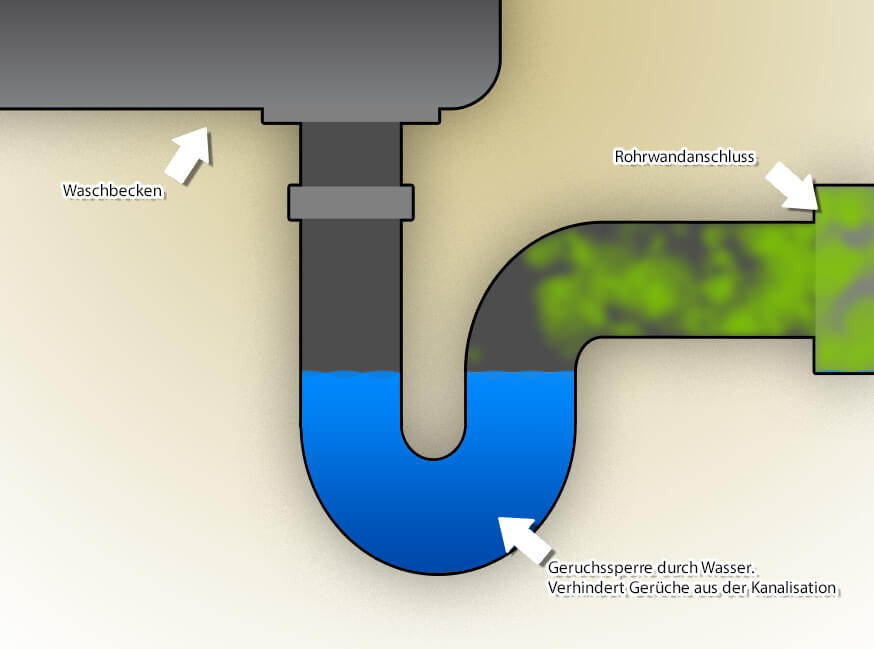
Although the siphon is a pretty good odor trap and generally keeps odors from the sewer away, unpleasant smells still occur from time to time and the drain smells. This essentially comes from the fact that over time material deposits at the bottom of the siphon and on the sides of the pipes. This deposited dirt consists, depending on the drain, mainly of soap, grease, hair and food residues. This slimy layer is an excellent breeding ground for bacteria, which set fermentation and decay processes in motion and thereby create gases that have an unpleasant smell.
It’s obvious that drains of toilets and kitchen sinks are most likely to clog and smell bad. Therefore, these should be cleaned and checked particularly often.
What Dangers Exist When Cleaning Drains?
Once the drain is clogged, you have to clean it again, and this can be quite dangerous for various reasons:
On the one hand, there is always a risk of infection, as the odors are caused by bacteria and decay processes. Therefore, you should ALWAYS wear gloves. But be careful: gloves do not always provide 100% protection. Here you should be very careful that the gloves are thick enough and have no damage. In addition, you should still think carefully during and after the work about which surfaces in the apartment you touch.
Also important: Afterward, it’s best to take a completely thorough shower or at least scrub your hands and arms very thoroughly. The risk of infection is quickly underestimated!
If possible, you should use gentle methods. If you don’t want to endanger your own health, you should use microorganisms. These do the work all by themselves (yes, really). The only thing you have to do is feed them regularly.
Fixing the Blockage or Dirt Yourself
First of all, it’s advisable to unscrew the lower pipe bend on the siphon (Attention! Be sure to put a bucket underneath beforehand!) and remove obvious dirt or blockages (by the way, you very often find long-lost jewelry in the siphon - a real treasure hunt that somewhat compensates for the bad smells and dirty work).
Then rinse everything thoroughly with hot water.
Mechanical cleaning naturally also carries a small potential danger, as you can injure yourself with the tools and sharp-edged pipe parts. So here too: better use gloves!
Damage to Pipes Through Tools and Wrong Chemicals/Cleaning Agents
In addition to the dangers for the person cleaning the drain, you can also damage the drain itself through cleaning. This can happen either through the tools themselves, or also through the harsh chemical drain cleaners. These attack plastic drains in particular, which is why they should be used even more rarely in these cases. Strong chemicals are also not necessarily the best solution against drain odor.
What to Do When the Drain is Clogged and Therefore Smells?
Home Remedies for Dissolving a Blockage
As with all our sections on home remedies, a warning in advance:
(Caution: Use at your own risk. These are untested home remedies, which will have unpredictable side effects when used. These are listed here merely for the completeness of the article.)
Soda Powder
One of the most popular home remedies against deposits in drains and the associated odors is soda! Simply put two tablespoons of soda in the drain and wait about half an hour. Then let plenty of cold water run. You can get soda in pharmacies and drugstores.
Baking Powder and Vinegar
Similar to soda, the combination of baking powder and vinegar also works. For this, put 3-4 tablespoons of baking powder in the drain and pour half a cup of vinegar after it. The vinegar makes the baking powder foam up really nicely and acts directly on the deposits. Here too, you have to let the whole thing work a bit - in this case, a quarter of an hour is enough. Then simply rinse with hot water.
Cola
When the drain smells and is clogged, cola can help. The phosphoric acid it contains also dissolves the deposits. Any cola from the supermarket works for this.
Although home remedies can help, they are often not sufficient for stubborn blockages. In addition, chemical reactions also occur here and you should also observe the common safety precautions.
Chemical Pipe Cleaners
If there is not only a blockage, but also a terrible smell that needs to go away immediately, only chemical pipe cleaners help. Often strongly caustic to be able to dissolve the dirt with force. However, even these don’t always help with an extremely strong blockage or are poured into the drain in such an amount that it becomes very expensive.
What also helps with light dirt or impending blockages are strong limescale removers, such as rea-calc®.
These agents are effective when the pipe is not completely clogged.
Air Pressure
There are countless possibilities to clear the drain with pressure. The simplest variant, which you should have at home for all emergencies, is a plunger or also called suction cup. Then there are suction pressure cleaners, which are simply a somewhat more modern variant of the plunger.
Preventing Blockages and Odors
Logically, in this case too, prevention is the best method. Therefore, you should heed the following tips:
Where possible, use sieve inserts, which prevent coarse impurities such as food residues and hair from getting into the drain in the first place. This also prevents the loss of jewelry and other objects.
In the kitchen, you should definitely make sure that no food residues are rinsed through the drain. These pieces, sauces and fats belong in the trash, and not in the sewer pipes, because they cause the drain to smell.
 The Easiest Solution: Microorganisms for Pipe Cleaning
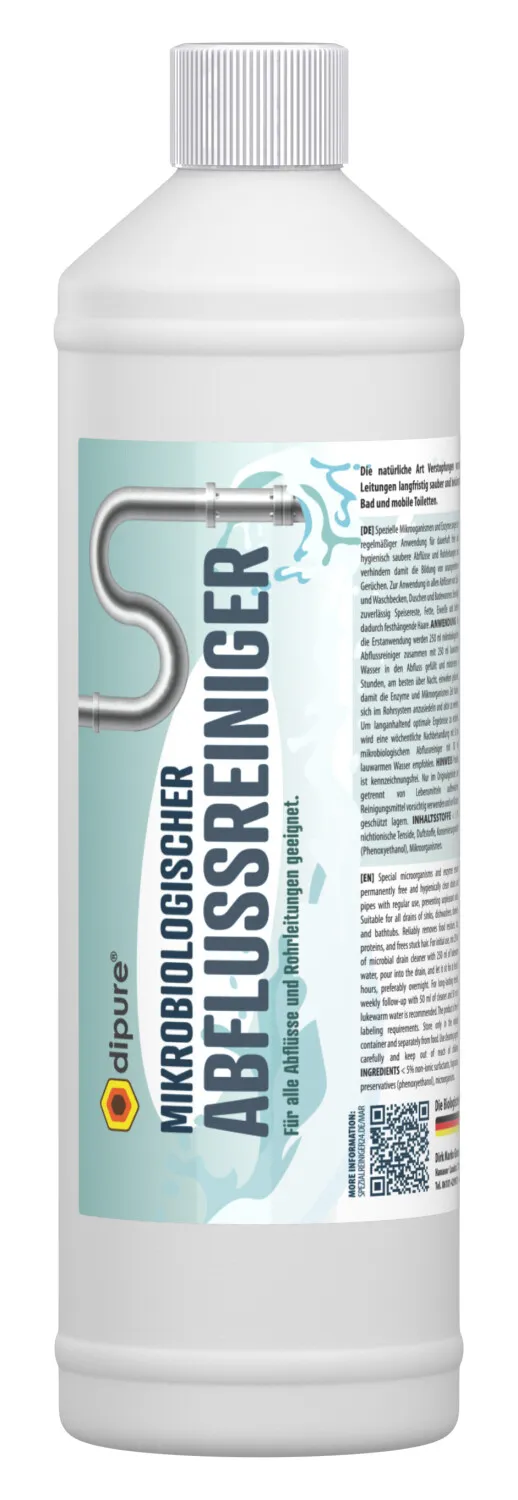
Keeping drains clean is work. At least it used to be. With our dipure® Microbiological Drain Cleaner it’s super easy and above all hygienic. Here, specially bred microorganisms help for a permanently clean drain.
With regular treatment, these settle in the drain and devour the most stubborn deposits there with the help of enzymes, including hair, food residues, protein and grease. The pipe is not attacked in the process.
Because no deposits can settle, odors are also prevented. Drain odor is therefore no longer a problem.
The only effort here is to pour these into the drain every 2 weeks. Much easier and cleaner than with spirals and similar tools.
When the Sink Drain Smells… Closing Words
When the sink drain smells, it’s basically already too late - so you shouldn’t let it get that far in the first place. Therefore, regular cleaning of the drains is important.
The use of sieve inserts and microorganisms means the least effort. This also means you do without caustic chemicals and thus help the environment. Microorganisms should be applied regularly to remain effective. This keeps drains free and bad odors away!
Updated on 02/24/2023